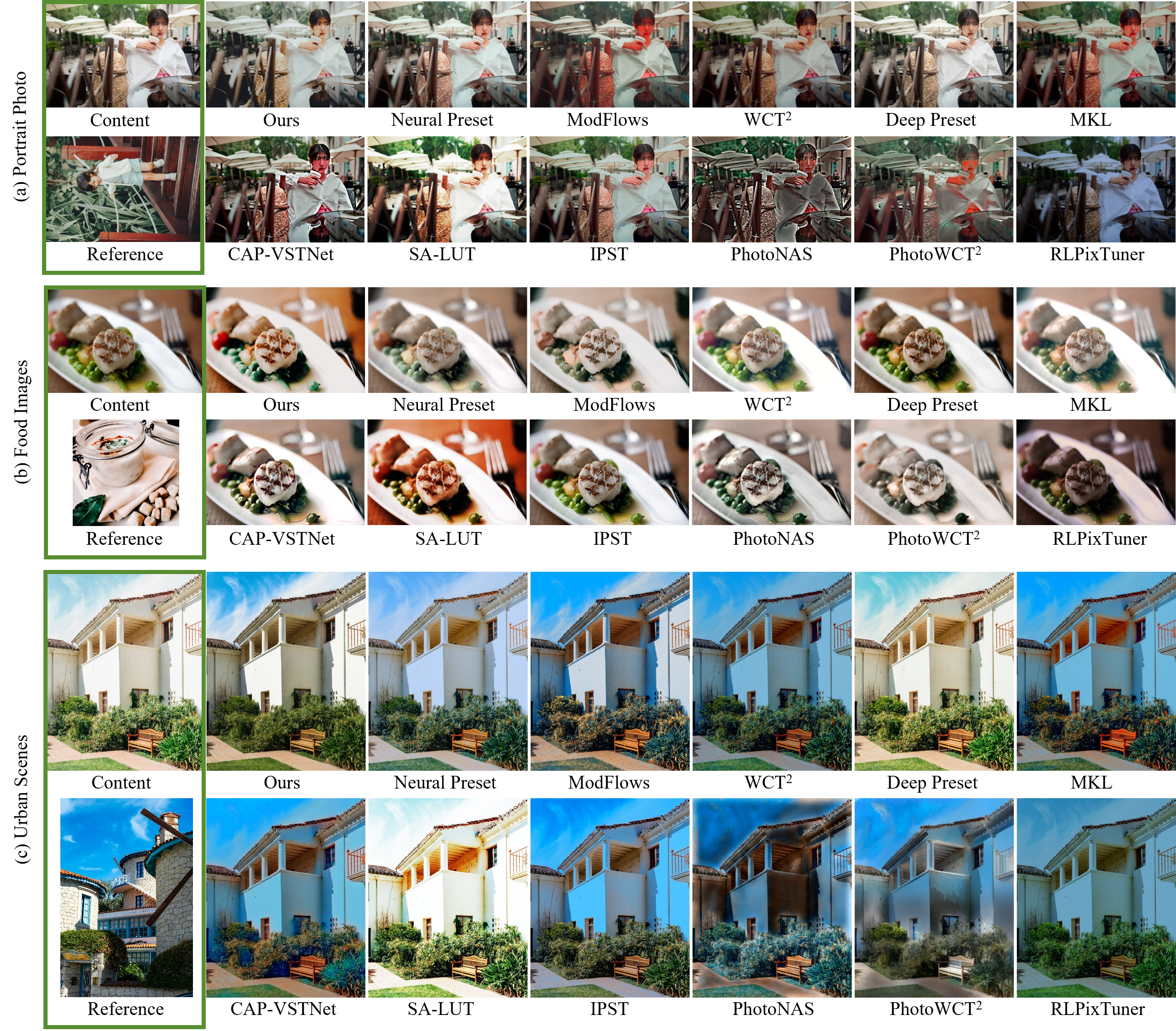
Qualitative Comparison
ICTone consistently avoids semantic misalignment, such as transferring object colors onto faces, and produces outputs closer to the stylized target across portrait, food, and urban scenes.
 Towards In-Context Tone Style Transfer with A Large-Scale Triplet Dataset
Tone style transfer for photo retouching aims to adapt the stylistic tone of the reference image to a given content image. However, the lack of high-quality large-scale triplet datasets with stylized ground truth forces existing methods to rely on self-supervised or proxy objectives, which limits model capability. To mitigate this gap, we design a data construction pipeline to build TST100K, a large-scale dataset of 100,000 content-reference-stylized triplets. At the core of this pipeline, we train a tone style scorer to ensure strict stylistic consistency for each triplet. We further propose ICTone, a diffusion-based framework that performs tone transfer in an in-context manner by jointly conditioning on both images, leveraging the semantic priors of generative models for semantic-aware transfer. Reward feedback learning using the tone style scorer is incorporated to improve stylistic fidelity and visual quality. Experiments demonstrate the effectiveness of TST100K, and ICTone achieves state-of-the-art performance on both quantitative metrics and human evaluations.
We construct the first large-scale content-reference-stylized triplet dataset and a carefully curated 2K benchmark for precise evaluation.
A two-stage scorer measures tone similarity, filters noisy triplets, and serves as a reward signal during model optimization.
An in-context diffusion framework that jointly reasons over content and reference images for semantically aware tone transfer.
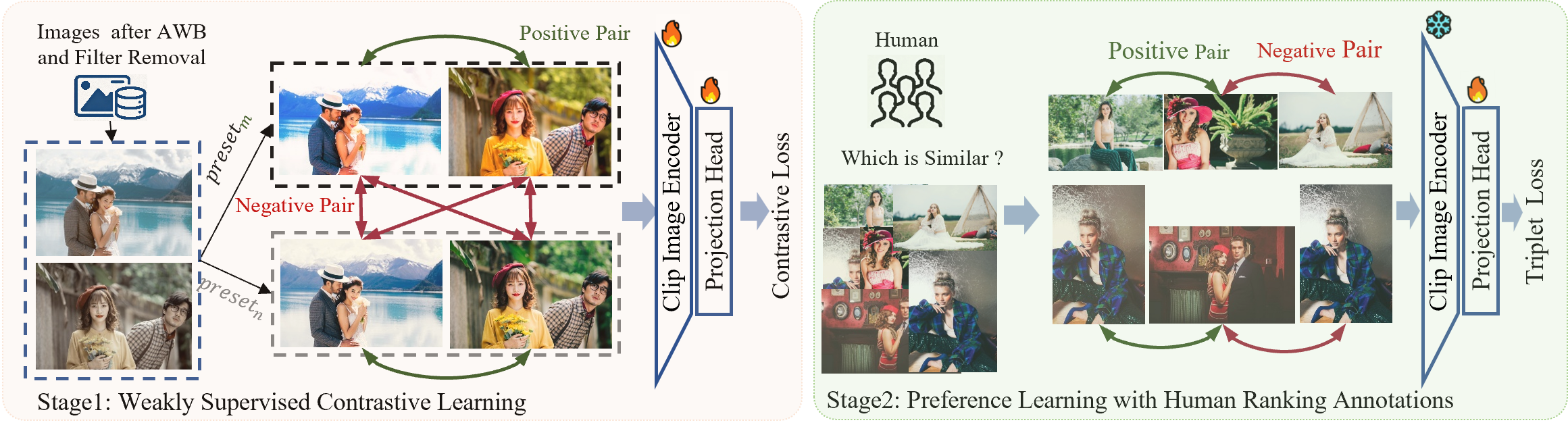
The tone style scorer is trained in two stages. It first learns coarse tone representations from preset-generated image pairs using weakly supervised contrastive learning, and is then refined using 20K human ranking annotations for better perceptual alignment.
This scorer is central to the project: it enables scalable construction of high-quality triplets and provides a reward function that explicitly pushes ICTone toward stronger reference tone fidelity.
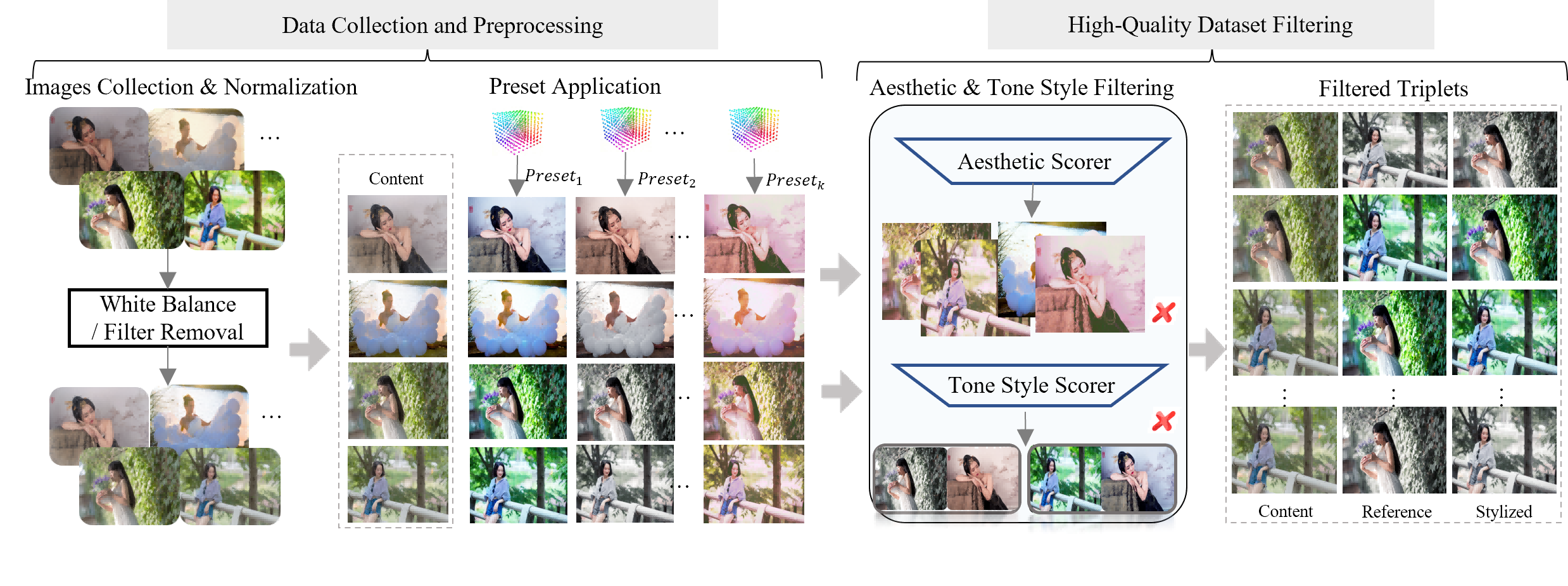
To address the lack of high-quality paired data, we build a large-scale dataset of content-reference-stylized triplets. Images are collected from high-quality public photo datasets, normalized to remove pre-existing tonal bias, and then edited with curated professional presets.
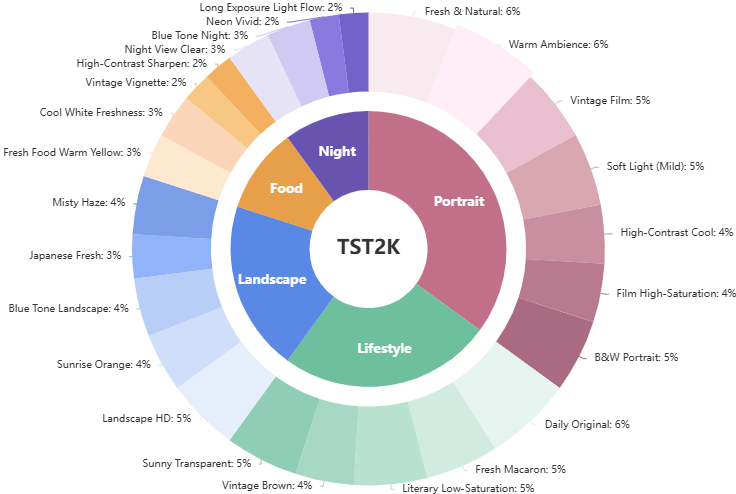
A dedicated tone style scorer and an aesthetic model jointly filter generated pairs, ensuring that each triplet is both tone-consistent and visually appealing. The final TST100K dataset contains 100,000 triplets, and TST2K provides a manually curated benchmark spanning portrait, food, landscape, night, and lifestyle scenes.
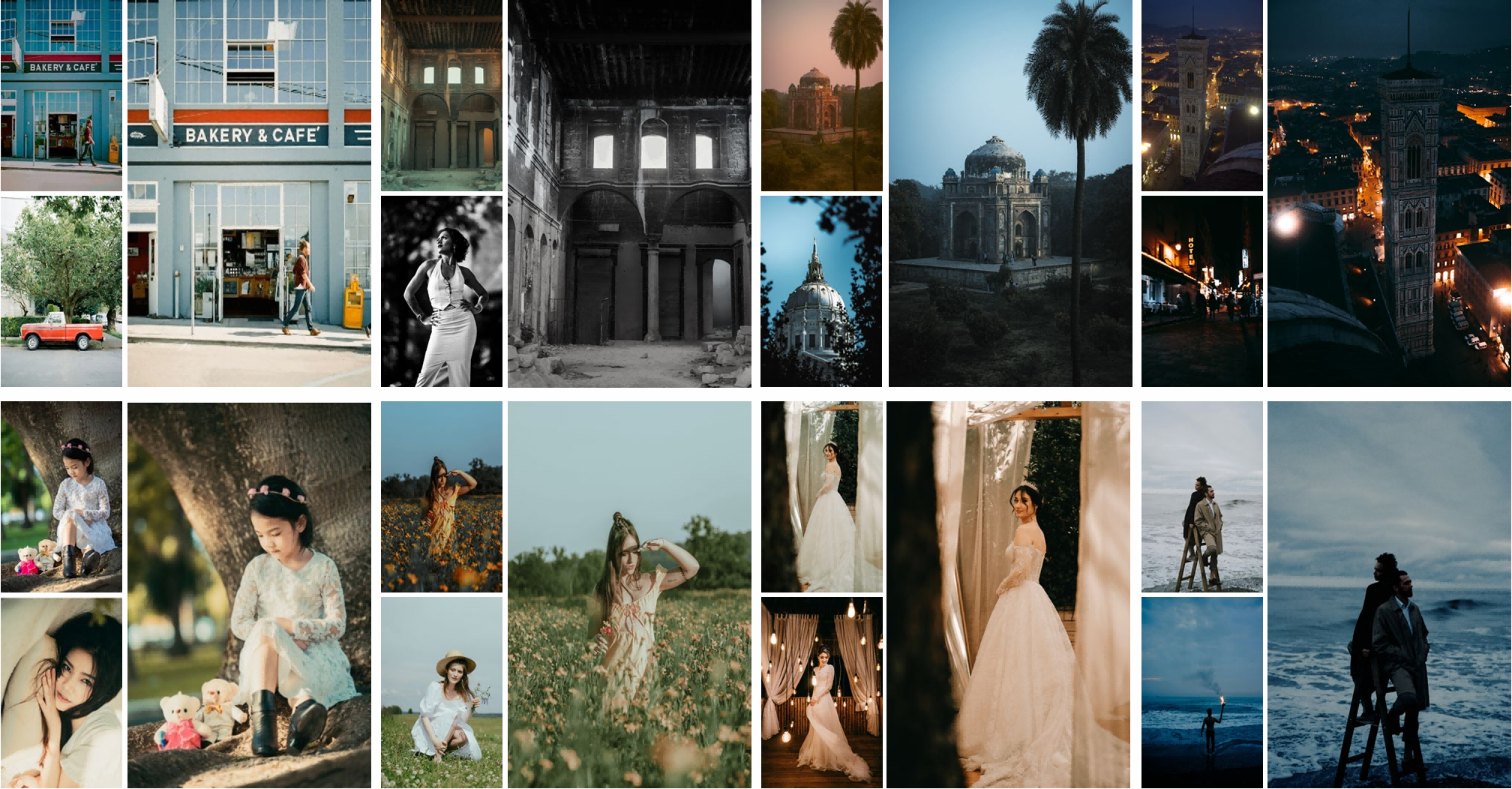
TST2K is a carefully curated benchmark derived from the large-scale construction pipeline for reliable evaluation. It includes representative image categories such as portraits, food, landscapes, night scenes, and lifestyle photography, covering a broad range of semantic structures and lighting conditions.
This benchmark complements TST100K by providing a smaller and cleaner test bed for both quantitative comparison and qualitative visualization, helping us assess whether a method can preserve scene content while faithfully matching the reference tone.
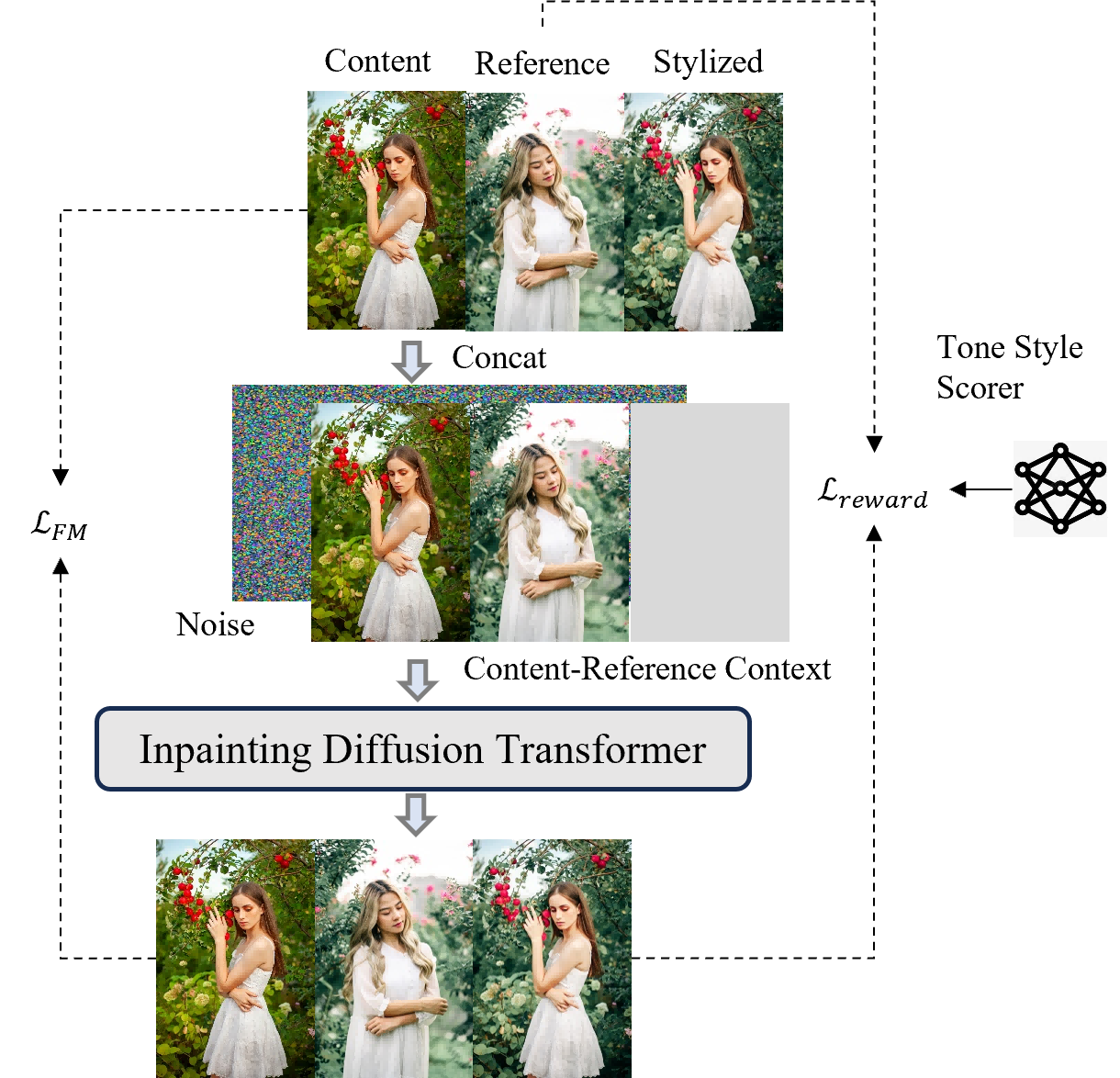
Existing methods usually encode content and reference separately before fusion, which can weaken semantic correspondence and lead to inappropriate color transfer. ICTone instead formulates tone transfer as an in-context generation problem.
By concatenating the content and reference images into a shared visual context for a diffusion inpainting model, ICTone leverages the semantic priors of large generative models to produce structure-aware tone transfer. Reward feedback learning based on the tone style scorer further improves stylistic fidelity and aesthetic quality.
ICTone achieves the best overall results on TST2K and strong generalization on PST50 across content preservation, color difference, deep color difference, and aesthetic quality.
Compared with prior methods, ICTone better preserves natural skin tones, color hierarchy, illumination coherence, and scene semantics.
Human evaluation ranks ICTone first, reflecting a strong balance among structural fidelity, tone consistency, and visual appeal.
Swipe on mobile or use the arrow controls to switch between qualitative figures and the quantitative/user study tables.
ICTone consistently avoids semantic misalignment, such as transferring object colors onto faces, and produces outputs closer to the stylized target across portrait, food, and urban scenes.
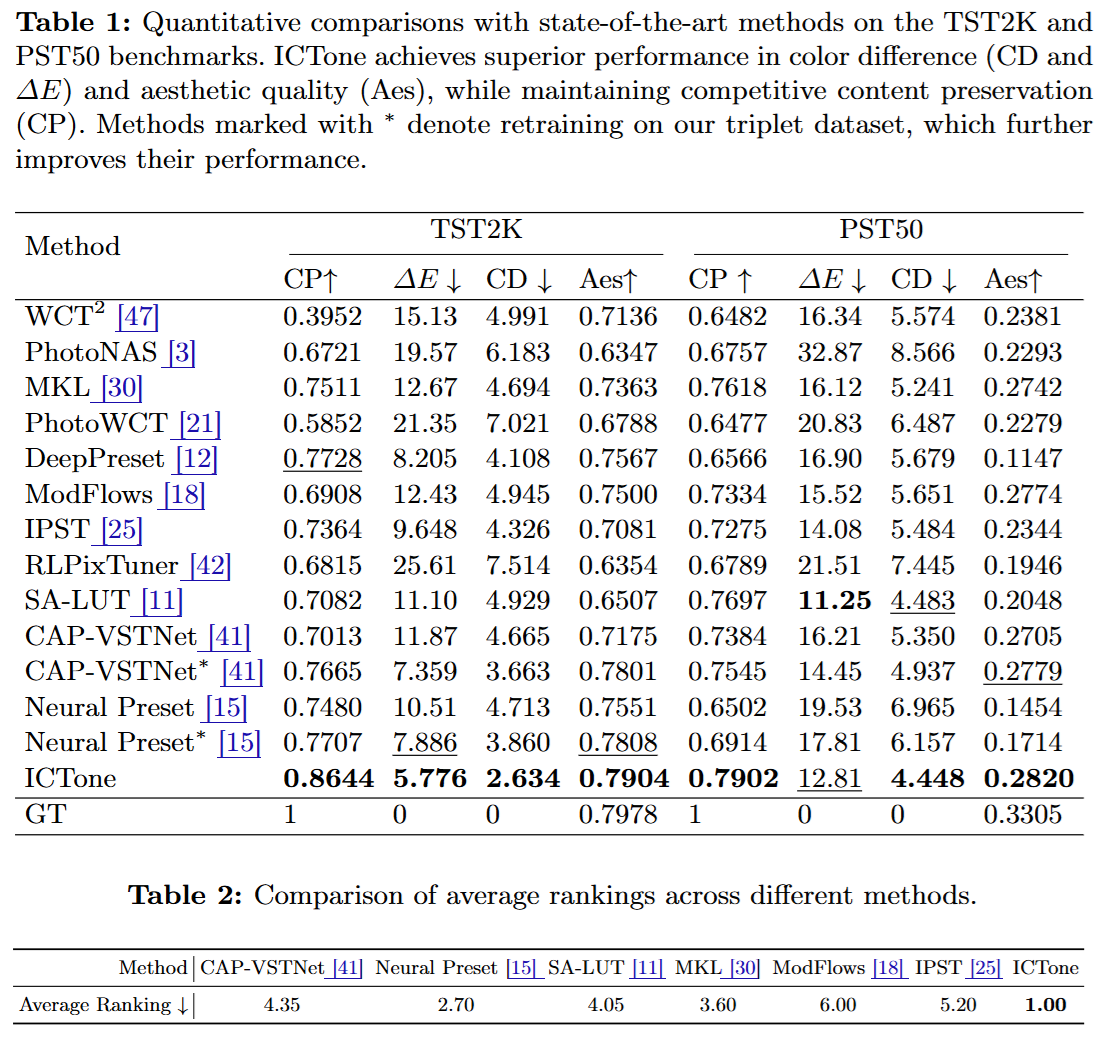
The quantitative benchmarks and user study both show strong performance for ICTone, highlighting better tone fidelity, preserved structure, and stronger overall preference from human evaluators.